Al-Shabaab gunmen take hostages after deadly Kenya university attack
Militants claim to be holding Christian hostages after dawn raid on hostels in which they opened fire on students and security guards, killing at least 15 people
Masked gunmen from Somalia’s al-Shabaab movement claim to be holding an unknown number of Kenyan Christians hostage after a dawn raid on a university compound that left at least 15 people dead.
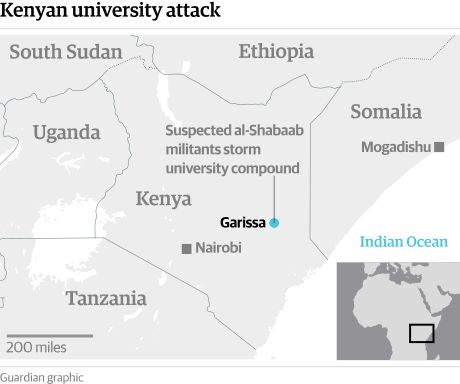
The attackers stormed into the university shortly after 5am in the town of Garissa, about 90 miles from the volatile border with Somalia. Kenya’s national disaster operations centre said 280 of the university’s 815 students were accounted for but did not say how many it believed to be still inside.
The gunmen were in one of four residential buildings, the interior ministry said.
Arnolda Shiundu, a spokesman for the Kenya Red Cross (KRC), told the Guardian that the attackers set off a blast at the gate of the university hostels before storming the compound and taking hostages.
“We sorted people out and released the Muslims,” Sheikh Abdiasis Abu Musab, al-Shabaab’s military operations spokesman, told Reuters.
“There are many dead bodies of Christians inside the building. We are also holding many Christians alive. Fighting still goes on inside the college.”
Witnesses said the attackers had shot indiscriminately at students and teachers who had been woken up by the mayhem. “They are just shooting randomly,” Augustine Alanga told the BBC World Service.
At least 50 students managed to escape to a nearby military facility after the initial sounds of gunfire and explosions, the KRC said. Witnesses described a scene of carnage with a huge crater left behind following the blast at the gate.
Collins Wetangula, the vice chairman of the student union, told the Associated Press he was preparing to take a shower when he heard gunshots coming from Tana dorm, which hosts both men and women. He said he locked himself and three roommates in their room.
“All I could hear were footsteps and gunshots nobody was screaming because they thought this would lead the gunmen to know where they are,” he said. “The gunmen were saying ‘sisi ni al-Shabaab’ (Swaihi for we are al-Shabaab),” Wetangula said.
When the gunmen arrived at his dormitory he could hear them opening doors and asking if the people who had hidden inside whether they were Muslims or Christians.
“If you were a Christian you were shot on the spot,” he said. “With each blast of the gun I thought I was going to die.”
The gunmen started to shoot rapidly and it was as if there was an exchange of fire, he said.
“The next thing, we saw people in military uniform through the window of the back of our rooms who identified themselves as the Kenyan military,” Wetangula said. The soldiers took him and around 20 others to safety.
Students of Garissa University College take shelter in a vehicle after fleeing the attack. Photograph: AP
Kenya’s new police chief, Joseph Boinett, who was appointed after the previous police commissioner was forced to retire following a spate of attacks in northern Kenya, said in a statement that police were “engaged in an elaborate process of flushing out the gunmen from the hostels”.
“I urge Kenyans to remain calm as our officers work to make sure that the attackers are ejected from the hostel and normalcy returns within the shortest time possible.”
Official report of current status vide Garissa attack. Thank you for your support.pic.twitter.com/I08RUALlFG
Kenya has been hit by a series of attacks blamed on al-Shabaab since its troops were deployed in Somalia in 2011 to tackle the al-Qaida affiliate. The UN-backed African Union troops have pushed al-Shabaab from virtually all major populated centres in the country but the rebels have hit back with a series of terror attacks inSomalia, Kenya and Uganda, another country contributing troops.
The four-day siege of the Westgate mall in Nairobi in September 2013 that left 67 dead was the most spectacular al-Shabaab atrocity so far, but the north of Kenya, which is primarily settled by Kenyan Somalis, has been the scene of a string of attacks, including the massacre of dozens of bus passengers in November.
Britain and Australia issued travel advisories warning against all travel to the north of Kenya and Coast province last week. The tourism industry, the biggest source of employment in Coast, has been seriously affected by falling arrival numbers as a result the attacks.
Students gather and watch from a distance outside the Garissa University College. Photograph: AP
North-east Kenya is one of the most impoverished parts of the country, where residents blame the state for years of marginalisation that has made the region an easy target for al-Shabaab operations and recruitment.
Efforts have been made to reverse the economic depredations in the area. The university, opened in 2011, is one of the key projects the government has rolled out. It has a student population of about 900, many of them from other parts of the country.
The pattern in other al-Shabaab attacks in recent years has been for the militants to separate Christians from Muslims and kill them at close range.
Libya's Arab spring: the revolution that ate its children Four years after Muammar Gaddafi was killed, the high hopes of Libya’s activists have crumbled as Isis fills the vacuum left by scrapping militias Libyans wave national flags on Martyrs’ Square in Tripoli as hundreds of people demonstrated in support of the UN-brokered dialogue between warring factions. Photograph: Hamza Turkia/Hamza Turkia/Xinhua Press/Corbis Chris Stephen in Tunis Monday 16 February 2015 12.02 EST Last modified on Monday 16 February 2015 12.19 EST Share on Facebook Share on Twitter Share via Email Share on LinkedIn Share on Google+ Shares 73 “It was better under Gaddafi,” says the young Libyan student, studying the froth bubbling over the top of his cappuccino in a cafe in Tunis as he contemplates the revolution that swept Muammar Gaddafi from power four years ago. “I never thought to say this before, I hated him, but things...
courtesy of | NATION MEDIA GROUP A fourth-year university student will spend two years in jail for posting on social media unprintable insults against President Uhuru Kenyatta. Alan Wadi Okengo, alias Lieutenant Wadi, was accused of posting the messages on his Facebook account on December 18 and 19 at an unknown place within Kenya. Wadi, 25, a political science student at Moi University, was arrested as he attempted to sneak out of the country through the Busia border on December 31. He was brought back to Nairobi CID headquarters where he was interrogated by cybercrime police sleuths. Wadi, who looked composed, told Milimani Law Courts resident magistrate Ms Ann Kaguru that he was ready to “apologise to President Kenyatta personally if he was not handed down a custodial sentence.” The charge against the university student stated that “the message he sent was calculated to to bring into contempt the lawful authority of the President of the Republic of Ke...


Comments
Post a Comment